
Artificial Intelligence is becoming increasingly relevant across vocational sectors, but for many educators the first challenge is knowing where to begin.
The SUSTaiN Starter Kit has been developed to make that starting point clearer. Bringing together three complementary resources, it helps vocational education and training educators move from understanding the fundamentals of AI, to exploring real examples from industry, and finally to identifying practical tools that can support teaching and learning.
At the heart of the Starter Kit are three resources: the Foundational AI and Machine Learning Overview, the Case Study Compendium, and the SUSTaiN Toolkit.
Build your understanding
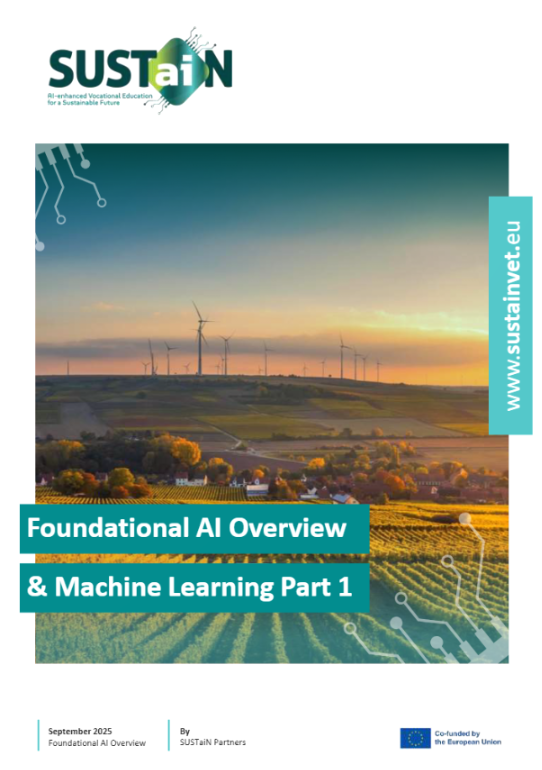
The Foundational AI and Machine Learning Overview introduces educators to the core ideas behind Artificial Intelligence and machine learning in an accessible way. It explains what AI and machine learning are, how they are connected, how AI systems operate and some of the ethical issues that need to be considered when these technologies are used.
Importantly, the resource connects this knowledge directly to vocational education. AI is already changing both the way education can be delivered and the skills learners will need in the workplace. The overview therefore considers how VET can respond to these changes and prepare learners for increasingly digital industries.
It then explores AI and sustainability across four areas at the centre of the SUSTaiN project: agriculture, water management, transport and energy. These sectors provide a practical context for understanding how AI can support areas such as resource optimisation, environmental monitoring, improved efficiency and more sustainable decision making.
See AI in action
Once educators understand the foundations, the Case Study Compendium shows what these ideas look like in practice.
The compendium brings together real examples of AI being applied across agriculture, water management, energy, and transport. Each case is presented through a clear Problem, Intervention and Outcome structure, helping educators see the challenge being addressed, how AI was introduced and what changed as a result.
Examples range from AI supported livestock and crop monitoring to predictive maintenance, smart grids, water analytics and new approaches to transport and logistics. This gives educators examples that can be discussed, adapted or used as starting points for classroom activities.
The value of these cases is that AI is no longer presented as an abstract technology. Learners can see its relationship with real workplaces, real sustainability challenges and real decisions.
Move towards practical application
The third part of the Starter Kit is the SUSTaiN Toolkit, which helps educators take the next step from understanding and examples towards practical exploration.
The toolkit brings together 11 AI powered digital tools relevant to agriculture, water, energy and transport. It has been designed to help educators understand the potential of AI for sustainability, bring AI into their teaching and use more innovative, technology enhanced approaches to learning.
Rather than simply listing technologies, the resource provides practical information including the purpose of each tool, its target audience, whether it is free or paid, and its strengths and limitations. This gives educators a clearer basis for deciding whether a particular technology could be useful in their own learning environment.
Three resources, one starting point
Together, the three resources create a simple learning journey:
Understand the technology. See how it is being used. Explore how it can be applied.
This is what makes the SUSTaiN Starter Kit particularly useful for VET educators. There is no expectation that educators already have advanced technical knowledge or experience with AI. The resources provide a route into the subject that connects technological understanding with sustainability, vocational practice and teaching.
As AI continues to influence sectors such as agriculture, water, energy and transport, VET has an important role in ensuring that learners are prepared not only to use emerging technologies, but also to think critically about how they can contribute to more sustainable ways of working.
The SUSTaiN Starter Kit provides a practical place to begin.