



Sustain Logo
This project has been funded with support from the European Commission. The author is solely responsible for this publication (communication) and the Commission accepts no responsibility for any use may be made of the information contained therein. In compliance of the new GDPR framework, please note that the Partnership will only process your personal data in the sole interest and purpose of the project and without any prejudice to your rights.

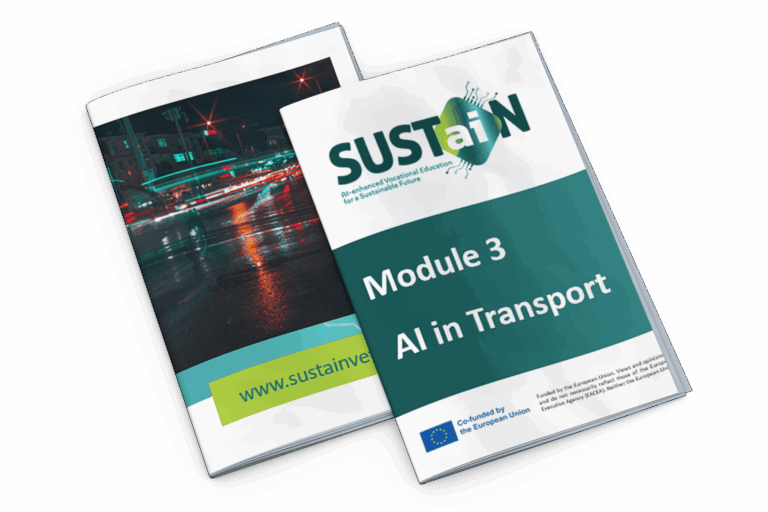
Module 3 - AI in Transport

Abstract graphic featuring colorful circuit lines and nodesAbstract graphic featuring colorful circuit lines and nodes

Moving towards smarter, safer transport

Transport systems are becoming increasingly connected and data-driven. Vehicles, infrastructure, traffic systems and logistics networks now generate large amounts of information that can be used to improve how people and goods move.

This module explores how Artificial Intelligence can help transport systems move from reacting to problems towards predicting and preventing them.

Why take this module?

From congestion and emissions to safety, maintenance and logistics, the transport sector faces complex challenges. AI can help professionals analyse information more quickly, anticipate problems and make better operational decisions.

But transport is also safety-critical. Understanding when to trust AI, when to question it and where human judgement must remain in control is therefore essential.

What will you explore?

  • The major challenges affecting modern transport
  • AI-supported traffic and logistics management
  • Predictive maintenance for vehicles and infrastructure
  • Smart and autonomous transport systems
  • AI applications in railway operations
  • Real examples including smart mobility and metro maintenance
  • Safety, privacy, explainability, bias and human oversight
  • The skills transport professionals will need in an AI-enabled workplace
  • Connections between transport, energy, agriculture and water systems

The module combines technological possibilities with an important question: how can AI enhance professional judgement rather than replace it?

Ready to see where transport is heading?
Download the module and then take the short quiz to test what you have learned.
Access the Module

1. What is described as the primary "evolution" of transport intelligence enabled by AI?(Required)
2. According to the module, what percentage of road traffic accidents is primarily caused by human error?(Required)
3. In the context of "The Data Challenge," why does most transport data remain underutilized?(Required)
4. How does AI specifically support sustainability in transport?(Required)
5. Which AI application in railway operations helps prevent costly breakdowns and improves safety by addressing issues before they occur?(Required)
6. In the Sofia Metro case study, what was a key "Lesson Learned" regarding the role of humans in AI systems?(Required)
7. Which competency is defined as "understanding what AI can and cannot do, when to trust it, and when to question it"?(Required)
8. Why should "Black box" AI systems be avoided in transport according to the module's strategies for integration?(Required)
9. What is the primary benefit of "Cross-Sectoral Integration" (e.g., linking Transport with Energy or Agriculture)?(Required)
10. According to the module's conclusions, what is the relationship between AI and professional judgment?(Required)
menu